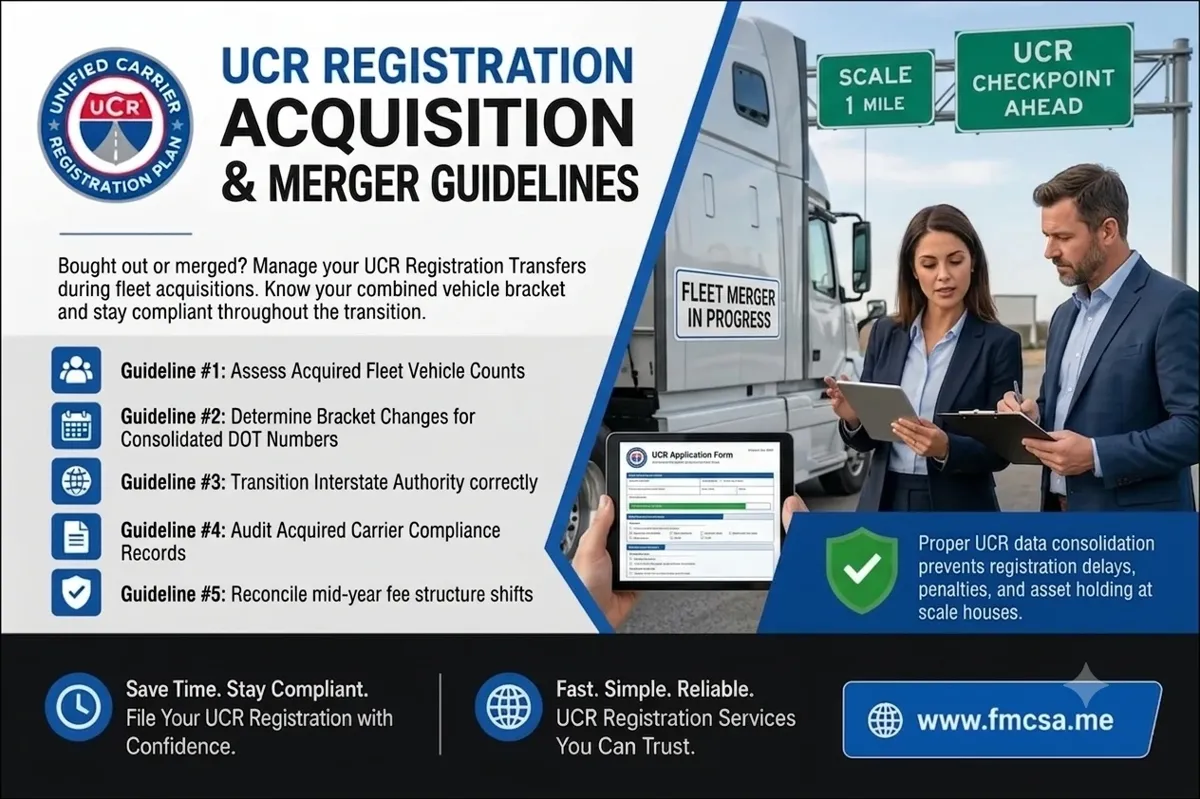
Bought Out or Merged? Managing UCR Registration Transfers During Fleet Acquisitions
Table of Contents
-
Introduction
-
Understanding Your Unified Carrier Registration Obligations
-
How Fleet Mergers Impact Your Annual Vehicle Brackets
-
Navigating DOT Number Changes and Authority Consolidation
-
Preventing Double-Filing Penalties and Enforcement Audits
-
Due Diligence: Checking Historical Compliance Records
-
Why Many Trucking Companies Choose Us
-
Frequently Asked Questions (FAQ)
Introduction
When one interstate trucking company acquires another or decides to merge operations, fleet managers face a mountain of logistical hurdles. Amid the chaos of combining payrolls, routing systems, and driver pools, regulatory compliance can easily stall. A major point of operational friction during a corporate transition involves the management of federal compliance profiles.
The Unified Carrier Registration system operates strictly on a company-by-company basis linked to active operating authorities. If your business undergoes an expansion or structural buyout, you cannot simply cross your fingers and assume your combined trucks are legally cleared to travel across state lines. A single unmapped tractor or a miscalculated fee bracket can trigger immediate scale house delays and severe enforcement penalties. Understanding how your regulatory liabilities shift ensures your expanded fleet stays fully operational throughout the transition.
Understanding Your Unified Carrier Registration Obligations
The Unified Carrier Registration (UCR) is an annual federal requirement for any motor carrier, broker, or owner-operator driving interstate. This program dictates that individuals and companies operating commercial motor vehicles in interstate or international commerce must register their business and pay an annual fee. The system replaces older compliance frameworks to create a unified database that state enforcement personnel use to verify active operational statuses quickly.
Because UCR is a mandatory annual registration, failing to keep it active is a severe operational risk. State troopers and roadside enforcement check your USDOT number against the federal registry to confirm compliance. If a carrier enters a jurisdiction without an active filing, the vehicle can be held at the scale house, disrupting delivery schedules and incurring steep administrative fines.
How Fleet Mergers Impact Your Annual Vehicle Brackets
Your annual filing fees are calculated using a strict tiered structure determined entirely by the size of your commercial vehicle fleet. The system places carriers into specific fee brackets based on the total number of power units owned or operated under their specific operating authority. For instance, a small owner-operator with one or two trucks falls into the lowest tier, while large fleets scale up through progressively higher brackets.
When an acquisition or merger takes place, your total fleet size shifts, which directly impacts your bracket placement. If Company A operates 15 trucks and acquires Company B, which operates 10 trucks, the combined operational fleet now totals 25 units. This growth moves the company out of the 6–20 vehicle tier and into the 21–100 vehicle bracket, causing a significant change in annual registration fees. Fleet managers must track these numbers carefully to ensure their next annual filing accurately reflects the new combined vehicle count.
Navigating DOT Number Changes and Authority Consolidation
During a corporate buyout, decisions must be made regarding which operating authority will remain active and which will be retired. If you choose to dissolve the acquired company's business structure and absorb its equipment, those trucks must be formally moved over to your surviving USDOT number.
This consolidation alters the data tied to your MCS-150 form, which is the official update document used by the Federal Motor Carrier Safety Administration to track active fleet sizes. Because the UCR system updates its records based on your current MCS-150 data, an abrupt spike in your vehicle count must be coordinated correctly. Failing to align the transfer of equipment with your updated federal profiles can lead to data mismatches, raising immediate red flags during roadside electronic checks.
Preventing Double-Filing Penalties and Enforcement Audits
One of the most frequent administrative mistakes made during fleet mergers is the accidental double-filing of registration fees. If an acquired company already paid its annual registration fee before the buyout took place, that fee is generally tied permanently to that specific entity and cannot simply be credited or refunded to a different corporate account.
Operating under two active registrations simultaneously for the same equipment creates bureaucratic confusion and risks an immediate audit. State regulators look closely at sudden fleet changes to ensure companies are not intentionally underreporting vehicle counts to stay in a cheaper bracket tier. Keeping clean, comprehensive records of exact asset transfer dates, vehicle identification numbers, and lease agreements is the only way to prove compliance if your business faces a state review.
Due Diligence: Checking Historical Compliance Records
Before finalizing any fleet acquisition, performing thorough due diligence on the target company's regulatory history is essential. You must verify whether the fleet you are buying has any outstanding compliance gaps, unfiled registration terms, or unpaid state penalties from previous operating years.
If you absorb a company that has failed to maintain its annual federal filings, the historical liability does not simply vanish. Regulatory agencies can hold the acquiring company responsible for resolving back-due balances before allowing new vehicle updates to clear the system. Reviewing the active status of every asset before it joins your roster protects your business from inheriting unexpected debts and sudden operational shutdowns.
Why Many Trucking Companies Choose Us
Navigating complicated federal registration updates while managing a corporate merger can overwhelm an internal compliance department. At FMCSA.me, we streamline the entire administrative lifecycle, ensuring your business paperwork is processed accurately and promptly.
Our optimized system enables your company to update vehicle counts, file required annual documentation, and reconcile fee tiers without dealing with confusing bureaucratic systems. If your team requires clear guidance during an acquisition, you can access our targeted resources to walk through updated filing protocols or review specialized carrier compliance paths to prepare your expanded operations for roadside inspections.
Whether you need to reconcile historical filings or register an entirely new subset of trucks under a unified corporate structure, you can rely on our online permit portal for rapid processing or safely log into your user panel to keep your operational authority completely unblemished.
Frequently Asked Questions (FAQ)
Can I transfer an existing UCR registration from an acquired company to my own?
No. Registrations are linked directly to a specific USDOT number and operating authority. They cannot be transferred between different corporate entities, meaning the surviving company must account for the new vehicles on its next annual update.
What happens if we add vehicles to our fleet mid-year after our filing is finished?
Your current registration fee is based on the vehicle count reported during your annual filing window. If your fleet grows mid-year, you generally do not pay an immediate supplement, but those new power units must be included when you file for the upcoming registration year.
Do trailers count toward our total vehicle numbers when calculating brackets?
No. For standard motor carrier filings, your bracket placement is determined strictly by your number of power units (tractors and straight trucks) rather than trailing units.
Are purely intrastate trucks exempt from these rules during a merger?
If a truck operates strictly within one state and never hauls cargo that originated out-of-state or internationally, it may be exempt. However, if those trucks handle any intermodal freight or cross state lines, they must be counted in your interstate vehicle totals.