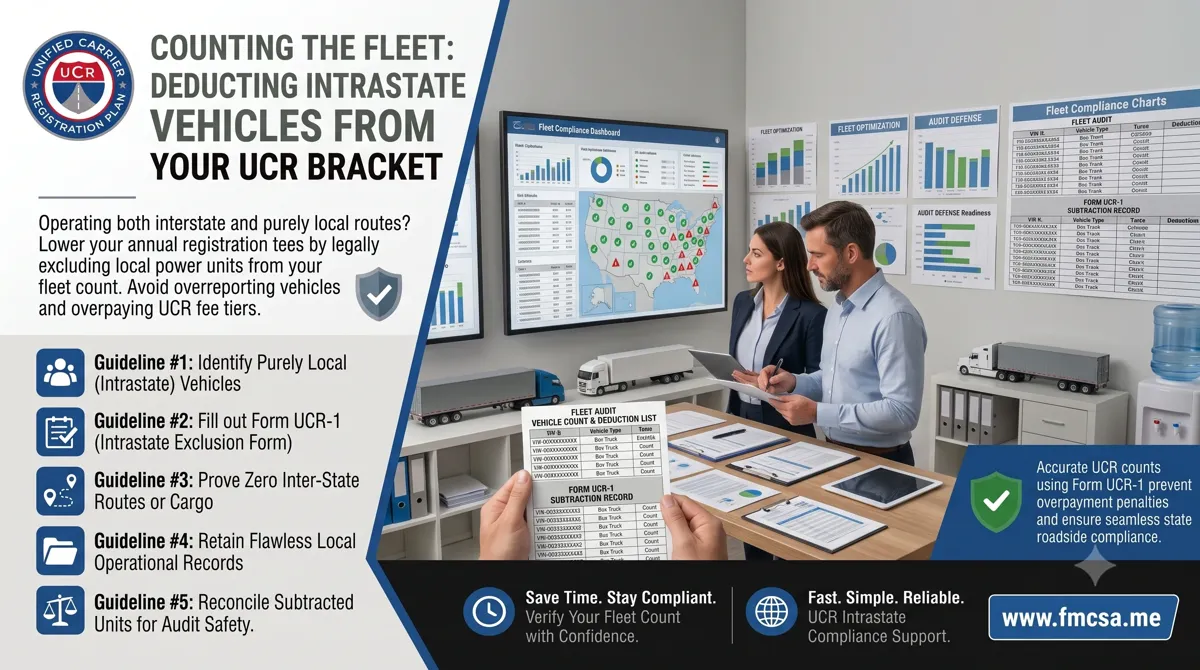
Counting the Fleet: The Legality of Deducting Intrastate Vehicles from Your UCR Bracket
Table of Contents
-
Introduction
-
The Financial Stakes: How UCR Brackets Work
-
The Legal Provision: When Can You Deduct a Vehicle?
-
The Hidden Traps of "Interstate Cargo" on Local Routes
-
The Paper Trail: Form UCR-1 and Required Documentation
-
Audit Preparedness: Retaining Records to Prove Your Fleet Count
-
Why Many Trucking Companies Choose Our Service
-
FAQ
Introduction
Managing an expanding commercial fleet requires constant attention to regulatory operating costs. For mid-sized carriers operating a mix of regional and local routes, annual compliance filings can rapidly become expensive if your vehicle inventory is not calculated precisely. One of the most frequent administrative accounting errors occurs during the annual Unified Carrier Registration cycle, where businesses inadvertently overreport their active vehicle numbers and pay for a much higher fee tier than legally required.
The UCR framework allows motor carriers to systematically manage their operational costs through legal exclusions. By understanding the strict boundaries between interstate commerce and purely local operations, fleet managers can legally deduct specific vehicles from their annual tier assessments. Doing so requires navigating precise state rules, keeping flawless records, and knowing exactly what qualifies as a purely local vehicle under federal guidelines.
The Financial Stakes: How UCR Brackets Work
The Unified Carrier Registration program structures its annual registration fees around a multi-tiered bracket system based entirely on the number of commercial motor vehicles (CMVs) a carrier operates. These brackets scale sharply: Tier 1 covers fleets with 0 to 2 vehicles, Tier 2 jumps from 3 to 5, Tier 3 spans 6 to 20, and the brackets continue upward for enterprise-level operations.
Because a difference of just one or two power units can push your business into a significantly higher price bracket, an unverified fleet count directly penalizes your bottom line. Many operations simply look at the total tractor count listed on their most recent MCS-150 biennial update and pay the corresponding tier fee. However, blindly copying that number often means you are paying federal fees on units that never legally participate in the interstate system.
The Legal Provision: When Can You Deduct a Vehicle?
Under the official provisions of the UCR agreement, both for-hire and private motor carriers have the legal right to subtract vehicles used exclusively for intrastate transportation from their final fleet count.
To legally deduct a commercial power unit from your annual UCR assessment, the vehicle must meet three strict, concurrent statutory requirements during the entire registration year:
-
Zero Boundary Crossings: The vehicle did not, or will not, travel outside the physical borders of its home state for any business purpose.
-
No Apportioned Plates: The vehicle must not be registered under the International Registration Plan (IRP). If a truck carries an apportioned plate, it is automatically deemed an interstate unit and cannot be deducted.
-
No Interstate Freight: The vehicle must not haul any property, waste, or recyclable materials that originated out-of-state or are ultimately destined for a location outside the state line.
The Hidden Traps of "Interstate Cargo" on Local Routes
The third requirement regarding cargo origin is where many carriers stumble during an administrative review. Federal enforcement guidelines clarify that a vehicle is legally engaged in interstate commerce if it ever, even once during the registration year, carries freight that began its movement in another state or country, or will finish its movement outside your home state.
Consider a regional distributor with a delivery truck that never physically leaves its home city. If that truck drives to a local rail yard or marine port to pick up containerized freight that originated overseas or in a neighboring state, that single haul legally classifies the movement as interstate commerce. Because the cargo crossed state lines, the power unit moving it must be counted toward your UCR registration tier, completely invalidating it for the intrastate deduction. Purely local operations must be completely isolated from the interstate supply chain to qualify.
The Paper Trail: Form UCR-1 and Required Documentation
You cannot simply subtract vehicles on the digital registration portal and log off; a legal deduction mandates a formal paper trail. When a carrier elects to exclude local power units to lower their fee bracket, they must complete and maintain an official Form UCR-1 (Notice of Intrastate Vehicles Subtracted).
Form UCR-1 requires the carrier to explicitly list the specific identity profiles of every excluded unit. For each vehicle subtracted, you must document the exact vehicle identification number (VIN), the state license plate number, the specific make and model, and the Gross Vehicle Weight Rating (GVWR). This signed form must be retained in your corporate compliance files. While it does not need to be uploaded during the initial online payment transaction, it must be instantly available for submission upon request by your base state registration authority.
Audit Preparedness: Retaining Records to Prove Your Fleet Count
State enforcement agencies regularly audit carrier registrations by cross-referencing safety databases, roadside inspection histories, and automated weigh station logs against paid UCR brackets. If an auditor discovers that a vehicle listed on your Form UCR-1 was pulled over or logged at a scale house while carrying an interstate bill of lading, your entire registration is compromised, triggering retroactive fee assessments, interest charges, and potential state citations.
To build an airtight audit defense, fleet managers must preserve comprehensive documentation for at least three years from the filing date. Your compliance files should include detailed vehicle mileage logs, localized driver trip sheets, and customer bills of lading corresponding to each subtracted unit. Proving a continuous pattern of purely local, intrastate movement is the only way to successfully validate your lower fee bracket during a routine state administrative review.
Why Many Trucking Companies Choose Our Service
Navigating changing state fee tiers, tracking rolling deadlines, and establishing correct base state designations can strain an internal administrative department. Many transportation businesses choose FMCSA.me to manage their annual credentialing workflows because we eliminate the operational guesswork. Our compliance specialists handle your structural updates, verify your exact fleet configuration to protect you from overpaying, and submit accurate, verified filings to ensure your trucks stay legally cleared at every state scale house nationwide.
FAQ
What happens if I buy a local truck mid-year and want to deduct it from my UCR?
Fleet size calculations are typically based on the number of commercial motor vehicles reported on your last MCS-150 form, or the number of units owned and operated during the 12 months ending June 30 of the preceding year. If you add a purely local unit mid-year, ensure your vehicle tracking logs and Form UCR-1 are updated immediately to reflect its operational limits.
Can I deduct a passenger van used strictly for local employee shuttles under the Unified Carrier Registration?
No. Official UCR guidelines specify that you may not list or subtract passenger-carrying vehicles (such as buses, transport vans, or limousines) on Form UCR-1. The intrastate exclusion option applies strictly to commercial motor vehicles designed and utilized for the transportation of property, freight, or waste.
Does a UCR filing receipt need to be placed inside the truck cab?
No. State law enforcement officials verify your carrier compliance electronically at roadside scale houses using your USDOT number. While your state-based office will issue a payment confirmation receipt, there is no legal requirement to maintain a physical hard copy inside the commercial vehicle.